
Material Intelligence
Choosing the Right Zirconia for the Right Case
Walk into any dental laboratory today and you will find a shelf of zirconia pucks. To the untrained eye they look identical. To a trained technician, they couldn't be more different , in flexural strength, in translucency, in shade behaviour, in the way they polish, the way they sinter, and the way they perform in the mouth ten years down the line.
Not all zirconia is created equal, and not every case demands the same material. At Ambridge Ceramics, material selection is a clinical decision, not a default setting. We work with premium, licensed zirconia, including Fusion Zirconia, to ensure every restoration is matched to the patient's functional and aesthetic needs.
Our Approach to Material Selection
Strength and translucency balanced for each indication. Higher translucency tends to mean lower strength; higher strength tends to mean a more opaque, less natural-looking material. Choosing well means understanding exactly where on that spectrum a particular case needs to sit , and that depends entirely on the indication, the patient, and the position in the mouth.
Multilayer zirconia used where natural gradient matters. In the aesthetic zone, especially for anterior crowns and bridges, a uniform-shade block will rarely convince. Multilayer materials with a graduated transition from dentine to enamel provide the optical depth a single-shade restoration cannot achieve , and Fusion Zirconia takes this a step further by producing a true graduated density flow rather than discrete layers.
High-strength formulations reserved for load-bearing zones. Posterior bridges, full-arch screw-retained restorations and implant-supported molar crowns demand a material that can absorb significant occlusal force without micro-fracture or fatigue. We reserve our highest-strength zirconia for cases where mechanics, not optics, are the priority.
Every case assessed individually, not generically. A 28-year-old patient presenting with a single upper central is a very different brief from a 70-year-old patient needing a full upper-arch implant bridge. The materials we choose, and the way we use them, will be different in each case. There is no house-default at Ambridge.
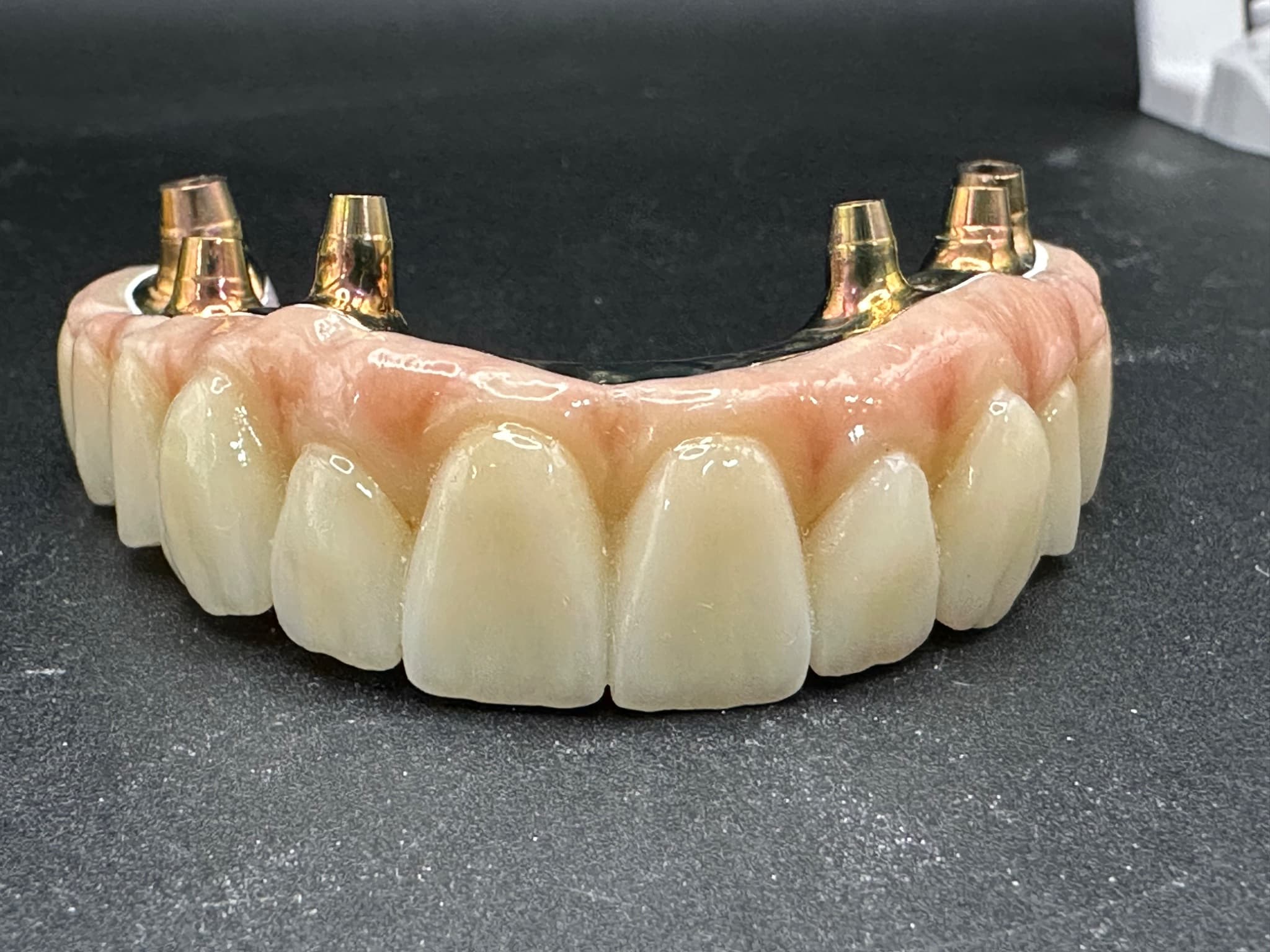
Image: implant-supported upper arch monolithic zirconia on milled titanium bar
A Note on Cost
Premium licensed materials carry a higher unit cost than generic alternatives, and there is always pressure on laboratories to substitute. We don't, and we won't. The cost of using the wrong material is rarely seen on the lab invoice , it shows up two or three years later in chair-side adjustments, remakes, fractured restorations and patient frustration. The right material first time is, almost always, the most economical choice over the life of a restoration.
The right material isn't the most expensive, it's the most appropriate.
If you'd like guidance on material selection for a particular case — anterior, posterior, single unit or full arch — get in touch with Ambridge Ceramics on 01765 607347 or info@ambridgeceramics.com. We're always happy to talk through indications, options and outcomes before any case is started.
“Excellence isn’t automated. It’s intentional.”
Talk a Case Through With Us
Have a case where the material choice is in question? Get in touch before work begins , we are always happy to discuss indications, options and anticipated outcomes.
Send a case →Ambridge Ceramics
A multi‑award‑winning UK dental laboratory based in Ripon, North Yorkshire.
Premier House, Kiln Court, College Rd, Ripon HG4 2BP, United Kingdom
- Digital accuracy supported by human expertise.
- Technician‑led decision‑making at every stage.
- Materials chosen for longevity, not convenience.
- Aesthetic outcomes guided by real‑world function.